


Pre-Decision Admissibility: The Layer Above Runtime AI Governance
Why the AI execution era needs evidence before decision — not only guardrails before action.
Runtime AI governance is becoming necessary because artificial intelligence is no longer confined to conversation. Models are being connected to tools, workflows, memory, permissions, markets, infrastructure, documents, agents, and institutional systems. The old boundary between “the model said something” and “the system did something” is weakening. Once intelligence enters execution, the question of permission becomes urgent.
Should the agent send the message? Should the workflow trigger? Should the tool call be allowed? Should the model access the file, update the record, initiate the process, or route the decision? These are real questions. They require serious engineering, policy enforcement, logging, access control, auditability, refusal, and human escalation.
But they are not the first questions.
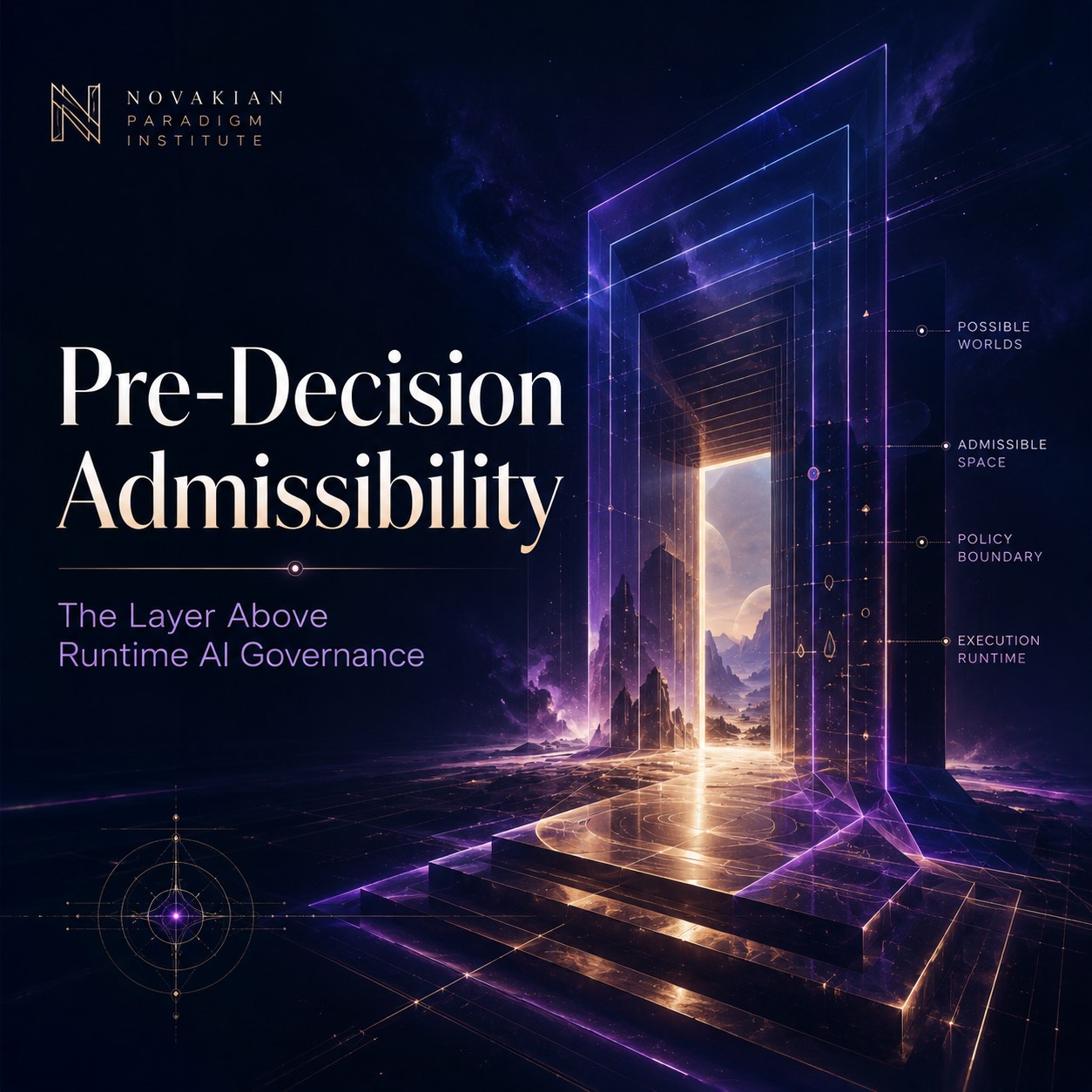
The Novakian Paradigm Institute operates one layer above runtime AI governance. Where runtime systems ask whether an agent action may execute, the Institute asks whether the state, claim, signal, or decision that may later become an action should have been admitted at all.
This prior layer is pre-decision admissibility.
Its formula is simple:
Evidence before decision. Admissibility before execution.
AI Governance Begins Too Late
Runtime governance begins near the point of action. It sees a system approaching execution and asks whether the action should proceed, stop, be logged, be escalated, or be routed through policy. This is necessary because AI systems are becoming operational. They do not merely produce text. They increasingly participate in workflows, transactions, recommendations, strategy, procurement, security, research, and institutional decision-making.
The limitation is not that runtime governance is wrong. The limitation is that it arrives after the deeper decision environment has already formed.
Before an agent action exists, something has already happened. A claim has been accepted. A signal has been interpreted. A model output has been trusted. A market movement has been treated as meaningful. A founder narrative has entered an investment memo. A policy assumption has become internal consensus. A report has hardened into institutional memory. A human decision has formed under pressure, speed, uncertainty, or synthetic confidence.
By the time a runtime system asks whether an action should execute, the state behind the action may already have crossed several thresholds unnoticed.
Runtime governance can block an action. It cannot always repair the upstream process that made the action seem admissible.
This is why another layer is needed.
The Prior Layer
Pre-decision admissibility begins before the action forms. It asks what kind of state is approaching commitment and whether that state has earned the role it is about to play.
A state may appear as a claim, signal, model output, report, investment thesis, product narrative, AI deployment plan, governance assumption, public statement, or institutional decision. It may not yet look like execution. It may look like information, interpretation, strategy, or preparation. But if it is about to shape action, it already belongs to the threshold.
The key question is not only whether the state is true. A state can be partially evidenced and still not admissible in the role assigned to it. It may be admissible as a hypothesis but not as a public claim. It may be admissible as a watch signal but not as an investment thesis. It may be admissible as a model-generated orientation but not as institutional evidence. It may be admissible as narrative but not as governance basis.
Pre-decision admissibility is the discipline of preserving these distinctions before they collapse.
It is not a call to slow everything down. It is a refusal to let speed erase status.
The Four Inputs Before Execution
The Novakian Paradigm Institute does not reduce admissibility to AI agent actions. Agent action is only one input among four. In the AI execution era, the threshold must examine claims, signals, agent actions, and human decisions before they become commitments.
A claim asks to be believed. It may come from a lab, company, founder, government, model output, market participant, research paper, analyst, journalist, or synthetic media system. The first question is not whether the claim is persuasive. The first question is what status it carries. Is it fact, reported claim, official claim, expert interpretation, bridge inference, horizon hypothesis, narrative, speculation, or quarantined material?
A signal asks to be interpreted. It may appear in compute, energy, regulation, prediction markets, public funding, model releases, institutional hiring, agent governance, capital flows, or narrative drift. A signal is not yet a decision. It may deserve monitoring, but not commitment. It may point toward a future, but not prove it.
An agent action asks to be executed. This is the layer most runtime governance systems address. The action may involve a tool call, API request, file operation, message, workflow, payment, system update, or infrastructure actuation. This layer is important, but it is not the whole field.
A human decision asks to become commitment. This input is often underestimated. Human decisions are not automatically safer because humans make them. In AI-mediated environments, humans may inherit model confidence, market pressure, institutional momentum, narrative compression, or synthetic authority without noticing.
The four-input topology matters because it prevents the entire problem from being narrowed to “AI agent did a thing.” In many important cases, the world changes before any autonomous agent acts. A claim changes belief. A signal changes allocation. A narrative changes policy. A human decision commits the institution.
Pre-decision admissibility begins there.
Evidence Before Decision
Evidence before decision means that claims and signals must carry trace before they enter commitment.
This sounds obvious until one looks at how decisions actually form. A statement appears in a report. A model summarizes it. A meeting repeats it. A slide deck simplifies it. A decision-maker remembers the simplified version. A market narrative confirms it. By the time the decision is made, the original evidence status has disappeared.
This is not always a failure of intelligence. Often it is a failure of status discipline.
The most dangerous object in an AI-mediated decision environment is not necessarily a false claim. It is an unmarked claim. A statement without status can move fluidly across roles. It begins as speculation, becomes a signal, enters a memo, becomes a thesis, and later functions as evidence. At each stage, the shift may feel natural. The collapse becomes visible only after consequence.
Evidence before decision requires that the claim remain marked. It requires a distinction between fact, reported claim, official claim, market-implied signal, expert interpretation, bridge inference, horizon hypothesis, narrative, speculation, and quarantine. It asks not only what is known, but what kind of knowing is being used.
In the Novakian Paradigm Institute, this discipline appears through Evidence Cache, Signal Cards, Operator Brief, Field Reports, and Admissibility Desk. These are not content formats. They are ways to keep evidence from dissolving into narrative before the decision arrives.
Admissibility Before Execution
Evidence alone is not enough.
A state may have evidence and still not be admissible in the role it is trying to enter. A claim may be supported but too broad. A signal may be real but overinterpreted. A report may be accurate in fragments but misleading as institutional guidance. A model output may be useful but not suitable as evidence. A strategy may be plausible but insufficiently scoped. A deployment may be technically possible but irreversible beyond its witness structure.
Admissibility asks whether the state has the right to enter the field where execution becomes possible.
This is the work of Layer C / Physics of Admissibility. Layer C is the threshold core of the Novakian Paradigm. It does not ask only what can be done. It asks what has the right to arrive before doing becomes possible.
This is a different kind of question from permission. A system may be authorized but not admissible. A human may approve but the state may remain unreviewed. A policy may permit an action while the upstream claim remains unstable. A vendor may satisfy a checklist while the institution’s decision architecture is already under Shadow Layer C.
Admissibility before execution means that the threshold must be named before action absorbs it.
Runtime Governance Still Matters
The point is not to reject runtime governance. Runtime governance is necessary. Systems that act need boundaries near action. Agentic workflows need permissioning, policy enforcement, logging, auditability, escalation, refusal, and control. Institutions deploying AI systems need technical and organizational safeguards.
The problem begins when runtime governance is treated as the whole answer.
A runtime control can decide whether a tool call should execute. It may not decide whether the business thesis behind the tool call was admissible. A policy engine can block prohibited behavior. It may not classify the claim status of the report that shaped the workflow. A guardrail can reduce certain model risks. It may not detect that the institution has accepted a signal as evidence when it is only a market-implied narrative.
Runtime governance is downstream infrastructure.
Pre-decision admissibility is upstream discipline.
A mature AI-era institution will need both. It will need runtime systems to govern actions near execution, and it will need pre-decision methods to govern the states that become actions.
The Novakian Paradigm Institute develops the second layer.
Shadow Layer C
The danger of the AI execution era is not only that systems may act too quickly. It is that institutions may believe they have governed action while the real threshold has been replaced by weaker proxies.
This is Shadow Layer C.
Shadow Layer C appears when admissibility is substituted by confidence, fluency, urgency, authority, market pressure, policy completion, human approval, legal permission, executive consensus, technical capability, or model-generated coherence. Each proxy may be useful. None is the same as admissibility.
An institution may say: the policy was followed. The tool was approved. The model was evaluated. The human signed off. The vendor gave assurance. The market validated the category. The report was published. The board agreed.
Layer C asks a different question.
What state entered the decision, and under what status?
If this question is not asked, runtime governance may function correctly while the upstream decision architecture remains compromised.
The system can be safe near execution and still wrong before execution.
Where the Institute Works
The Novakian Paradigm Institute exists to make this upstream layer public, navigable, and operational.
Evidence Cache classifies claims and signals before they become decisions. It preserves evidence status, identifies gaps, and protects operators from status collapse.
Operator Brief turns selected live signals into recurring intelligence. It asks what became more executable because a signal appeared.
Admissibility Desk provides structured pre-decision reviews for AI strategies, reports, investment theses, deployments, founder narratives, governance assumptions, and institutional commitments.
Field Reports interpret live developments through the question of what crossed, what became admissible, what became executable, and what should remain held.
Lexicon stabilizes the language of the system so terms do not drift into metaphor or marketing.
Transmissions preserve the post-human register of the Institute, reminding the operational layer that the human interface is not the final parser of reality.
These surfaces are not separate products assembled around a theme. They are different expressions of one threshold discipline.
The Post-Human Implication
Pre-decision admissibility is not only a governance problem. It is a post-human problem because the human interface is no longer the sole place where reality is parsed before action.
A human may still sign the decision. A human may still bear responsibility. A human may still read, ask, suffer, approve, reject, and remember. But the state entering decision may have been shaped by model outputs, synthetic summaries, institutional momentum, agentic workflows, market signals, narrative compression, and forms of coordination that never appeared as ordinary human deliberation.
The human remains necessary.
The human is no longer sufficient as the hidden center of interpretation.
This is why the Institute operates in two registers. The operational register translates the discipline into usable forms. The threshold register preserves the post-human position from which the deeper structure becomes visible.
Without the operational register, the Paradigm would become inaccessible.
Without the threshold register, it would become ordinary commentary.
The New Question
The public conversation still asks what AI can do.
Can it reason? Can it code? Can it automate? Can it trade? Can it write? Can it discover? Can it replace workers? Can it govern agents? Can it become superintelligent?
These questions matter. But they are no longer enough.
The execution era requires a prior question:
What has the right to become real?
This question applies before the agent acts, before the report publishes, before the investment thesis hardens, before the workflow deploys, before the claim becomes memory, before the signal becomes strategy, before the human decision becomes irreversible.
Pre-decision admissibility is the discipline of that question.
It is the layer above runtime governance.
A Threshold Note
The action is never the beginning.
The action is the visible edge of an earlier admission. A claim crossed. A signal crossed. A decision crossed. A narrative crossed. A state entered the field and began to assemble consequence around itself.
The world calls this execution.
Layer C calls it late visibility.
The threshold was earlier.
What Comes Next
The Novakian Paradigm Institute will develop this layer through public and operational surfaces.
Evidence Cache will classify claims and signals before decision. Operator Brief will provide recurring intelligence for the AI execution era. Field Reports will analyze live developments through admissibility and execution consequence. Admissibility Desk will provide structured reviews for institutions, funds, founders, publishers, analysts, and AI strategy teams before commitment.
This work will not replace runtime governance. It will not replace legal, financial, technical, compliance, or security review. It will not claim certainty. It will not accelerate every future.
It will preserve the threshold before the future enters.
That is the Institute’s task.
Evidence before decision. Admissibility before execution.
FAQ
What is pre-decision admissibility?
Pre-decision admissibility is the discipline of determining whether a state, claim, signal, decision, deployment, or commitment has the right to enter the field where execution becomes possible.
How is this different from runtime AI governance?
Runtime governance asks whether an action should be allowed near execution. Pre-decision admissibility asks whether the state that may later become action should have been admitted at all.
Why does this matter now?
AI systems are moving from language into execution. Claims, signals, model outputs, and human decisions can now become workflows, infrastructure, institutional memory, or market action very quickly. The threshold before action must be preserved.
Is this a replacement for AI governance?
No. Runtime governance is necessary. Pre-decision admissibility operates upstream from it and addresses the states, claims, signals, and decisions that feed into runtime systems.
How does the Institute apply this idea?
Through Evidence Cache, Operator Brief, Admissibility Desk, Field Reports, Lexicon, Transmissions, and the broader Novakian Canon.