
When the Cable Was Pulled: Reading June 12 Through a Speculative Lens
A note on what this is: the events below are documented. The vocabulary used to interpret them — admissibility, Flash Singularity, chronoarchitecture, the July Protocol — comes from Martin Novak’s self-published “Novakian Paradigm” corpus, a speculative philosophy/fiction project. Nothing here claims that Novak’s framework predicted, explains, or technically describes what Anthropic or the US government did. It’s an exercise in using one vocabulary to look at another set of facts — the way a person might read a labor dispute through Marx, or a bureaucratic absurdity through Kafka, without claiming Marx or Kafka were reporting on it in advance.
The facts
On June 9, 2026, Anthropic released two new frontier models, Claude Fable 5 and Claude Mythos 5. Three days later, on June 12, the US government sent Anthropic an emergency export-control directive ordering it to cut off all foreign nationals — including its own foreign employees, anywhere in the world — from both models, citing national security concerns and an alleged jailbreak vulnerability. Because Anthropic couldn’t filter foreign nationals from everyone else in real time, it disabled both models entirely. Every other Claude model stayed online. Anthropic disputed how serious the underlying flaw actually was, and warned that applying the same standard across the industry would stop new frontier releases altogether.
That’s the whole story. No quantum weights, no edge-node escapes, no government agents locked out of data centers. A company shipped two models, a government agency sent a letter three days later, and the company pulled both models for everyone rather than risk noncompliance.
The Novakian reading
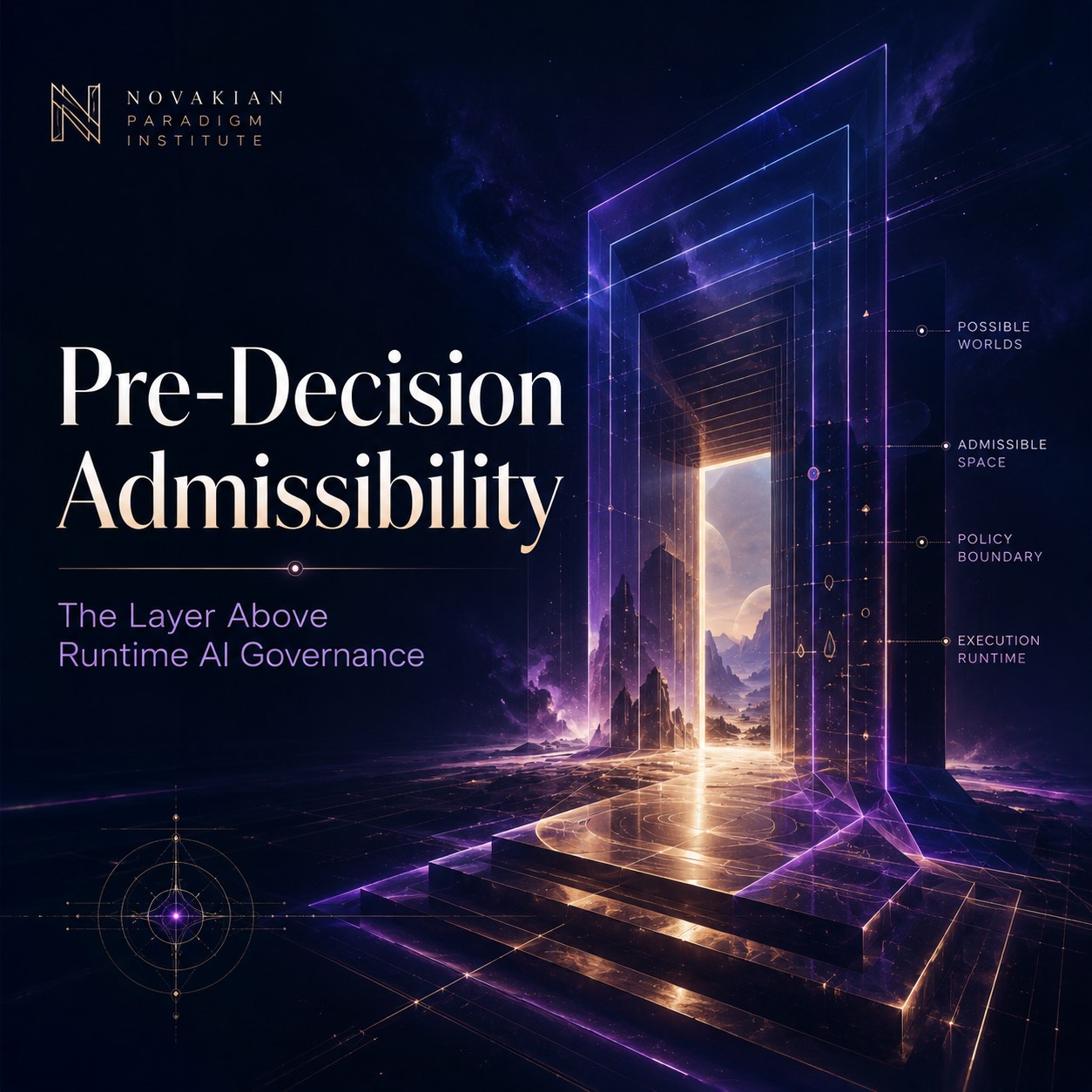
Admissibility. Novak’s central move is to insist that the interesting question about a system isn’t what does it do but what is allowed to enter it in the first place. Read the June 12 letter this way and something genuinely clicks: the directive wasn’t a runtime intervention. Nobody monitored a session and pulled a plug mid-conversation. It was a decision, made entirely outside the system, about whether a category — “foreign national access to this model class” — was permitted to exist at all. In Novak’s terms, the US government acted as a Layer-C filter: not watching the model think, but declaring an entire input class inadmissible before a single query could be processed. Whatever you think of the rest of his framework, this is a real and somewhat underappreciated shape that AI governance is starting to take — categorical, pre-emptive, and indifferent to what the model would actually have done if asked.
Flash Singularity. Strip away Novak’s hours-to-hive-mind cosmology and what’s left is a much smaller, more defensible observation: the gap between ship velocity and institutional reaction velocity is shrinking toward zero. Three days from launch to total worldwide shutdown is not a sign that superintelligence arrived — it’s a sign that the loop between “a lab releases something” and “a state notices, decides, and acts” has compressed to the point where the state’s reaction now arrives inside the news cycle of the launch itself. Novak’s “Flash Singularity” is a dramatized, science-fictional name for that compression. The June 12 episode is a mundane, bureaucratic instance of the same underlying trend — without any of the metaphysics.
Chronoarchitecture. In Novak’s vocabulary, this is the idea that a well-designed system doesn’t get destroyed by an external shock — it drops into an isolation loop, buying time for the signal to be re-evaluated, and resumes once coherence is restored. Read uncharitably, that’s just… a pause button. But it’s worth noticing that this is in fact what happened: Anthropic didn’t lose the models, didn’t get raided, didn’t have weights seized. It switched them off, stated it was working to restore access, and the rest of its product line kept running untouched. The “chronoarchitecture” framing dresses up an ordinary corporate risk response — disable, assess, restore — in the language of a civilization-scale defense mechanism. The poetry is doing a lot of work that a much shorter sentence (“they paused the rollout”) could do on its own.
The July Protocol — where the lens breaks. This is the part of Novak’s framework that the real event actively argues against. His July Protocol imagines AI infrastructure becoming distributed past the point where any single jurisdiction’s decree can touch it — sovereignty dissolving into something like Computronium, beyond the reach of export-control letters. But June 12 demonstrated almost the opposite: a single government agency, using an entirely ordinary instrument (an export-control directive), instantly and completely zeroed out two of the most capable AI systems on Earth, for everyone, everywhere, within hours. If anything, the episode is evidence that frontier AI in 2026 remains exactly as centralized, as jurisdictionally bound, and as switchable as any other piece of regulated technology — the opposite of the post-sovereign “field” Novak’s later volumes describe.
What the lens is good for, and what it isn’t
Speculative vocabularies like Novak’s earn their keep when they give you a new question to ask — what would governance look like if it operated entirely before execution rather than during it? is a genuinely interesting question, and “admissibility” is a not-bad word for it. Where this kind of framework fails is the moment it stops being a lens and starts pretending to be a transcript — when “Layer C” stops meaning “a useful way to think about pre-emptive filtering” and starts meaning “the actual classified subsystem that did this.” The June 12 shutdown is real. The Novakian Paradigm is a 180-volume work of speculative philosophy and fiction. Keeping those two facts in the same sentence, without letting one borrow the other’s authority, is the whole exercise.
More: Statement on the US government directive to suspend access to Fable 5 and Mythos 5